
Research summary for educational purposes only. Not medical advice. Ghost Pulse materials are not for human use.
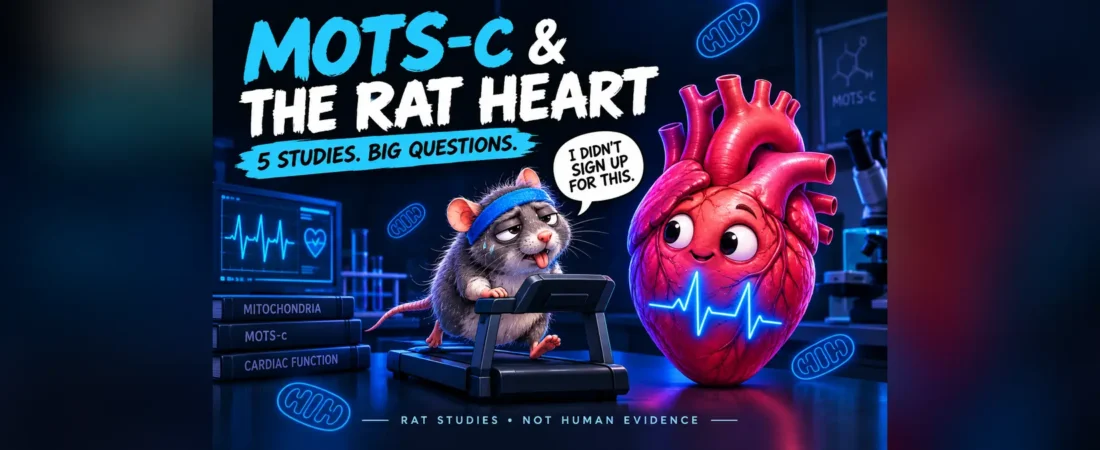
Picture a rat on a treadmill. Ten-degree incline. An hour a day, five days a week, for three straight months. He did not sign up for this. He has no idea he’s about to become one of the more interesting data points in mitochondrial peptide research. He just wants a snack.
That rat, and a few dozen of its colleagues, are the reason people keep asking about MOTS-c and the heart. So let’s look at what the MOTS-c heart research actually measured, what they found, and where the receipts get a little thin.
What’s in this MOTS-c breakdown
First, what is MOTS-c?
MOTS-c is a 16-amino-acid peptide encoded not in your nuclear DNA, but in the small genome inside mitochondria, within a region of the 12S rRNA gene. It was described in 2015 by Pinchas Cohen’s lab at USC in Cell Metabolism, where researchers showed it acts on AMPK, the cell’s main energy sensor, and improved insulin sensitivity in mice on a high-fat diet.
In plain terms: it’s a signal the mitochondria send out when the cell’s energy situation changes. And few organs care more about energy than the heart, which never gets a rest day.
MOTS-c Heart Study 1: Healthy rats, treadmill, 12 weeks
Yuan et al., Scientific Reports (2021). Young male Sprague-Dawley rats were split into three groups: sedentary controls, exercise only, and exercise plus daily MOTS-c. After 12 weeks, the team measured heart function with a pressure-volume catheter, the gold standard for seeing exactly how a ventricle fills and squeezes.
What they found:
- Better efficiency. The exercise-plus-MOTS-c group had higher myocardial mechanical efficiency than both exercise-only and control rats. Same work, less energy wasted.
- Stronger contractility index. The preload-recruitable stroke work slope, a load-independent measure of how hard the heart muscle contracts, was higher than in both other groups.
- More AMPK activity. Phosphorylated AMPK in heart tissue rose only in the MOTS-c group.
- Higher heart MOTS-c levels. Exercise alone raised MOTS-c in heart tissue, and adding it on top raised it further.
The fine print: it wasn’t a clean sweep. Stroke work and cardiac output were actually lower in the MOTS-c group than in the exercise-only group. The MOTS-c rats also showed a rise in ANP, a marker linked to cardiac hypertrophy, which the authors flagged as something they didn’t investigate. Translation: the heart got more efficient, but “more efficient” and “more output” aren’t the same thing.
MOTS-c Heart Studies 2–4: Diabetic rats
Diabetic cardiomyopathy is where the heart muscle weakens and stiffens from long-term high blood sugar. To model it, researchers fed rats a high-fat diet for several weeks, then gave a low dose of streptozotocin to knock out part of their insulin production. Then they tested MOTS-c, exercise, or both for 8 weeks.
Li et al., Frontiers in Endocrinology (2022). Diabetic rats had lower ejection fraction than controls. In the MOTS-c group, ejection fraction was no longer different from healthy controls. Electron microscopy showed less mitochondrial swelling and restored cristae, the folded inner membranes where energy gets made. Gene analysis pointed to the NRG1-ErbB4 pathway, a known cardioprotective signal, which dropped in diabetic hearts and came back with either MOTS-c or exercise. The authors described MOTS-c as mimicking part of exercise’s protective effect.
Wang et al., Frontiers in Nutrition (2023). Same model, different angle. MOTS-c brought ejection fraction, the E/A filling ratio and left ventricular wall thickness back toward control values. It also restored PGC-1α, the master switch for building new mitochondria, and citrate synthase activity, a stand-in for mitochondrial content. The proposed mechanism: lowering CCN1, which dials down the ERK1/2 and EGR1 stress-signaling chain.
Tang et al., Scientific Reports (2023). This one looked at oxidative stress. MOTS-c, alone or with exercise, raised the antioxidant enzymes SOD and catalase, activated the Nrf2 antioxidant pathway and lowered markers of lipid damage. The combination of MOTS-c and treadmill running beat either one alone on lipid damage and AMPK activation.
Study 5: A second lab weighs in
Pham et al., Frontiers in Physiology (2025). A team at the University of Auckland used a similar diabetic rat model and a short three-week course. MOTS-c restored mitochondrial respiration in left ventricle tissue, improved glucose handling and reduced cardiac hypertrophy. Some things didn’t move: ATP production and fatty-acid-fueled respiration were unchanged.
This study matters more than its size suggests, and here’s why.
The honest MOTS-c scorecard
We said we’d show receipts, so here they are:
- Four of the five studies come from one research group at Chengdu Sport University. That’s not a red flag on its own, but real confidence comes when independent labs reproduce the results. Auckland’s study is a good start.
- Only male rats were used in every study here.
- Small groups, often 7 to 10 animals each.
- One dose, one route per study. Nobody has mapped what amount does what.
- Mechanisms are mostly correlational. Gene expression moved alongside heart function, but the pathways weren’t blocked to prove cause and effect.
- Some reporting inconsistencies. A couple of papers have figure captions and text that don’t fully agree on significance.
- Rats aren’t people. No human trials on MOTS-c and heart function exist yet.
The takeaway
Across five rat studies, MOTS-c kept showing up on the same side of the ledger: healthier mitochondria, better energy signaling through AMPK, less oxidative stress, and heart function that held up better under the strain of a diabetes model. In healthy, trained rats it made the heart more efficient, though not more powerful than exercise alone.
It’s a consistent and genuinely interesting signal. It’s also early, mostly from one lab, and entirely in rodents. That’s exactly why it’s still a research compound, and why the next wave of independent studies is the one to watch.
As for our treadmill rat: we hope he got his snack.
More Ghost Pulse Peptide Research
- TB-500 Research: The Honest Truth Behind 6 Key Studies, including thymosin beta-4’s own heart repair work.
- BPC-157 Achilles Tendon Research: 2 Rat Studies
- No Hype, Just Receipts: How Ghost Pulse Handles Research
Looking for research-grade MOTS-c with a real COA? Browse the Ghost Pulse shop.
MOTS-c FAQ
What is MOTS-c?
MOTS-c is a 16-amino-acid peptide encoded in the mitochondrial genome, within the 12S rRNA gene. It was described in 2015 by Pinchas Cohen’s lab at USC, which showed it acts on AMPK, the cell’s main energy sensor.
What does MOTS-c heart research show?
In five rat studies, MOTS-c was linked to healthier heart mitochondria, stronger AMPK signaling, lower oxidative stress and better-preserved heart function in diabetic rat models. In healthy trained rats it improved heart efficiency, though not output, compared with exercise alone.
Has MOTS-c been studied in human hearts?
No. There are no human trials on MOTS-c and heart function yet. The studies covered here were all done in male rats, and four of the five came from one research group.
How is MOTS-c related to exercise?
Exercise raised MOTS-c levels in rat heart tissue, and several studies found MOTS-c mimicked part of exercise’s protective effect on the heart. The combination of MOTS-c and treadmill training often outperformed either one alone.
References
- Lee C, et al. The mitochondrial-derived peptide MOTS-c promotes metabolic homeostasis and reduces obesity and insulin resistance. Cell Metabolism. 2015;21(3):443–454. doi:10.1016/j.cmet.2015.02.009
- Yuan J, et al. The mitochondrial signaling peptide MOTS-c improves myocardial performance during exercise training in rats. Scientific Reports. 2021;11. doi:10.1038/s41598-021-99568-3
- Li S, et al. MOTS-c and exercise restore cardiac function by activating of NRG1-ErbB signaling in diabetic rats. Frontiers in Endocrinology. 2022;13:812032. doi:10.3389/fendo.2022.812032
- Wang M, et al. MOTS-c repairs myocardial damage by inhibiting the CCN1/ERK1/2/EGR1 pathway in diabetic rats. Frontiers in Nutrition. 2023;9:1060684. doi:10.3389/fnut.2022.1060684
- Tang M, et al. The role of MOTS-c-mediated antioxidant defense in aerobic exercise alleviating diabetic myocardial injury. Scientific Reports. 2023;13. doi:10.1038/s41598-023-47073-0
- Pham T, et al. Mitochondria-derived peptide MOTS-c restores mitochondrial respiration in type 2 diabetic heart. Frontiers in Physiology. 2025;16:1602271. doi:10.3389/fphys.2025.1602271
Follow @ghostpulse_io on TikTok, X & Instagram for more research breakdowns & cheeky lab-nerd content.
Disclaimer: Not Medical Advice. This article is for educational and informational purposes only and is not medical advice. All information is based on peer-reviewed scientific studies that are publicly available, linked in the references above. The studies discussed were conducted in rats and do not establish safety or effectiveness in humans. Consult a qualified healthcare professional for any medical questions.
Research Use Only. Products sold by Ghost Pulse are intended for in vitro and laboratory research only and are not for human or veterinary use. They are not intended to diagnose, treat, cure, or prevent any disease.