
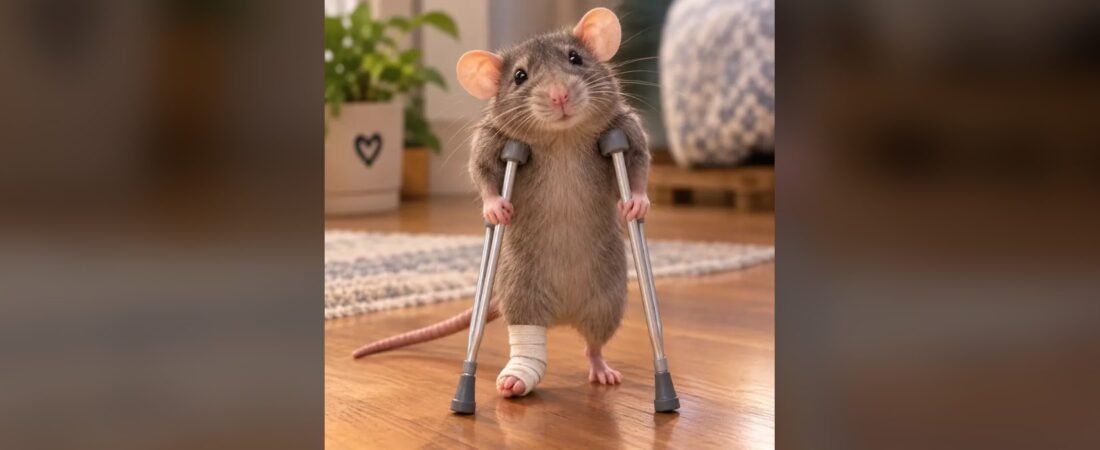
Somewhere in a lab in Zagreb, Croatia, a rat had a very bad day. No failed deadlift. No sketchy box jump. Researchers cut his Achilles tendon on purpose, in the name of science.
Then they gave some of those rats a 15-amino-acid peptide called BPC-157 and watched what happened. Spoiler: the treated rats had a much better comeback arc.
Let’s break down the research, the plot twists, and the fine print.
First, Why Tendons Are the DMV of Tissues
Tendons connect muscle to bone. The Achilles is the big one connecting the calf to the heel, and rats have one too. Tendons are tough, but they’re notoriously slow healers. They get a low blood supply, so repair crews show up late and work slowly. If tendon healing had a customer service line, the hold music would never end.
That makes tendon repair a hot topic in research labs. Anything that speeds things up gets attention.
Meet BPC-157: The Peptide With a Superhero Name
BPC stands for Body Protection Compound. It’s a pentadecapeptide, meaning a chain of 15 amino acids, derived from a protein found in gastric juice. Yes, stomach juice. Science finds its heroes in strange places.
Most of the foundational research comes from Professor Predrag Sikirić’s group at the University of Zagreb, which has been studying BPC-157 in animal models for decades.
Study #1: The Cut Tendon (2003)
In 2003, Staresinic and colleagues published a study in the Journal of Orthopaedic Research. They cut the Achilles tendon of rats about 5 mm above the heel bone, leaving a gap. Then they split the rats into groups:
- Rats that got BPC-157, at three different dose levels, by daily injection into the abdominal cavity
- Control rats that got plain saline (the scientific equivalent of “thoughts and prayers”)
The team checked in on days 1, 4, 7, 10 and 14. They tested how strong the tendons were, how well the rats walked, and what the tissue looked like under a microscope.
The results:
- Stronger tendons. The BPC-157 group’s tendons took more force before failing and were stiffer, the way healthy tendon should be.
- Better walking. Treated rats scored higher on the Achilles functional index, basically a rat gait report card.
- Better tissue. Under the microscope: better collagen and fibroblast formation, fewer of the inflammatory cells you see in a messy wound.
- Smaller gaps. Visually, the defect was smaller and shallower, and tendon integrity was restored.
The control rats? The researchers described their healing as severely impaired. Rough week, fellas.
Plot Twist: Bodyguard, Not Personal Trainer
The same team grew tendon cells in a dish. You’d expect BPC-157 to make them grow like crazy. It didn’t. On its own, it didn’t change their growth at all.
Then they added HNE (4-hydroxynonenal), a nasty byproduct of oxidative damage that shuts down cell growth. HNE alone put the brakes on the cells. With BPC-157 in the mix, that inhibition disappeared and even flipped into stimulation.
Translation: in this experiment, BPC-157 didn’t act like a personal trainer yelling “ONE MORE REP.” It acted like a bouncer, standing between the cells and the stuff trying to wreck them.
Study #2: The Hard Mode Version (2006)
Cutting a tendon is one thing. Ripping it clean off the bone is another. In 2006, Krivic and colleagues, also in the Journal of Orthopaedic Research, detached the Achilles tendon from the heel bone entirely. That tendon-to-bone junction is notorious for not healing on its own.
They followed the rats for up to 21 days. BPC-157 rats showed:
- Better function scores
- Higher load to failure and stiffness
- More organized collagen fibers and more type I collagen, the main structural collagen in tendon
- More advanced blood vessel development at the repair site
They also threw in a curveball: a corticosteroid (methylprednisolone). Steroids are known to slow tendon healing, and it did exactly that here. In rats given both, BPC-157 substantially counteracted the steroid’s drag on healing.
The Fine Print (Read This Part, Seriously)
Before anyone gets carried away, here’s the reality check:
- These were rats. Rat tendons aren’t human tendons, and plenty of things that work in rodents never pan out in people.
- Mostly one research group. Much of the BPC-157 literature comes from the same Zagreb lab. Independent replication matters.
- Controlled lab conditions. Surgical injury models, lab-prepared compounds, tightly controlled protocols.
- No approved human use. BPC-157 is not approved by the FDA for any human use, and these studies don’t establish safety or effectiveness in people.
Big headlines, small rodents. Keep it in the lab.
The Bottom Line
In two rat studies, BPC-157 was linked to stronger, better-organized, faster-healing Achilles tendons, including in the notoriously stubborn tendon-to-bone model and even against a steroid working against it. Fascinating early research, and a big reason BPC-157 keeps showing up in tendon and soft-tissue research.
Somewhere out there, a retired lab rat is walking just fine. Respect.
Follow @ghostpulse_io on TikTok, X & Instagram for more research breakdowns & cheeky content.
References
- Staresinic M, et al. Gastric pentadecapeptide BPC 157 accelerates healing of transected rat Achilles tendon and in vitro stimulates tendocytes growth. J Orthop Res. 2003;21(6):976–983. PubMed
- Krivic A, et al. Achilles detachment in rat and stable gastric pentadecapeptide BPC 157: promoted tendon-to-bone healing and opposed corticosteroid aggravation. J Orthop Res. 2006;24(5):982–989. PubMed
Disclaimer: Not Medical Advice. This article is for educational and informational purposes only and is not medical advice. All information is based on peer-reviewed scientific studies that are publicly available, linked in the references above. The studies discussed were conducted in rats and do not establish safety or effectiveness in humans. Consult a qualified healthcare professional for any medical questions.
Research Use Only. Products sold by Ghost Pulse are intended for in vitro and laboratory research only and are not for human or veterinary use. They are not intended to diagnose, treat, cure, or prevent any disease.