
Research education only. Not medical advice. Ghost Pulse materials are for research use only and not for human consumption.
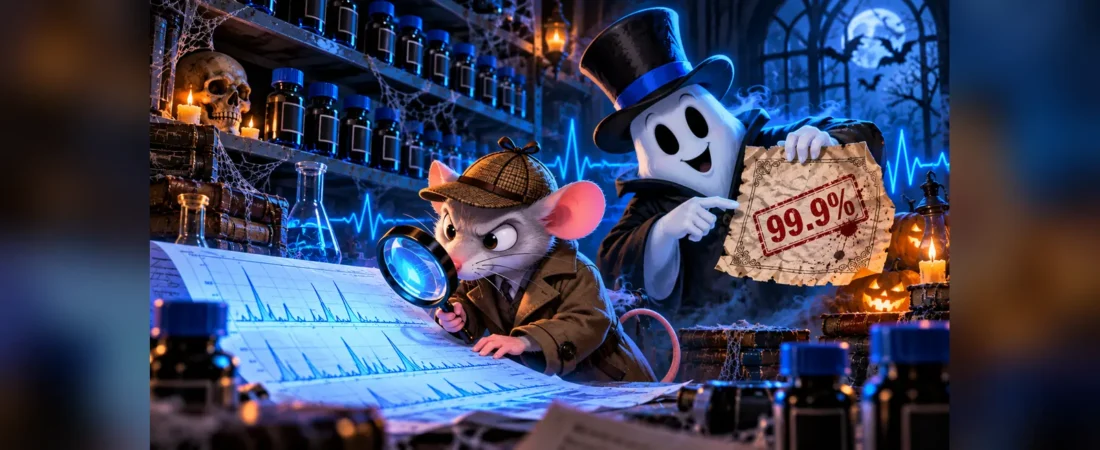
A peptide COA (Certificate of Analysis) is the receipt that proves what’s actually in the vial. A fake one is a ghost story with a PDF attached. Happy Halloween. Here’s how to read a peptide COA like a pro and spot the fakes before your research gets haunted.
Spoiler: most fake COAs aren’t clever. They’re lazy. Once you know the five things a real one has, the bad ones jump out like a jump scare in a Blumhouse movie.
What’s in this peptide COA guide
The Peptide COA Basics: Missing Any of These? Hard Pass.
Before you even look at a purity number, check that the peptide COA has the boring stuff. Boring is good. Boring means a real lab did real work.
| Check | Legit | Spooky |
|---|---|---|
| Lab | A real lab you can look up | “Lab Testing Inc.” with no website, or the vendor grading its own homework |
| Batch # | Matches the label on your vial | Missing, or “see label” |
| Test date | Recent, after the batch was made | 2019. Or next Tuesday. |
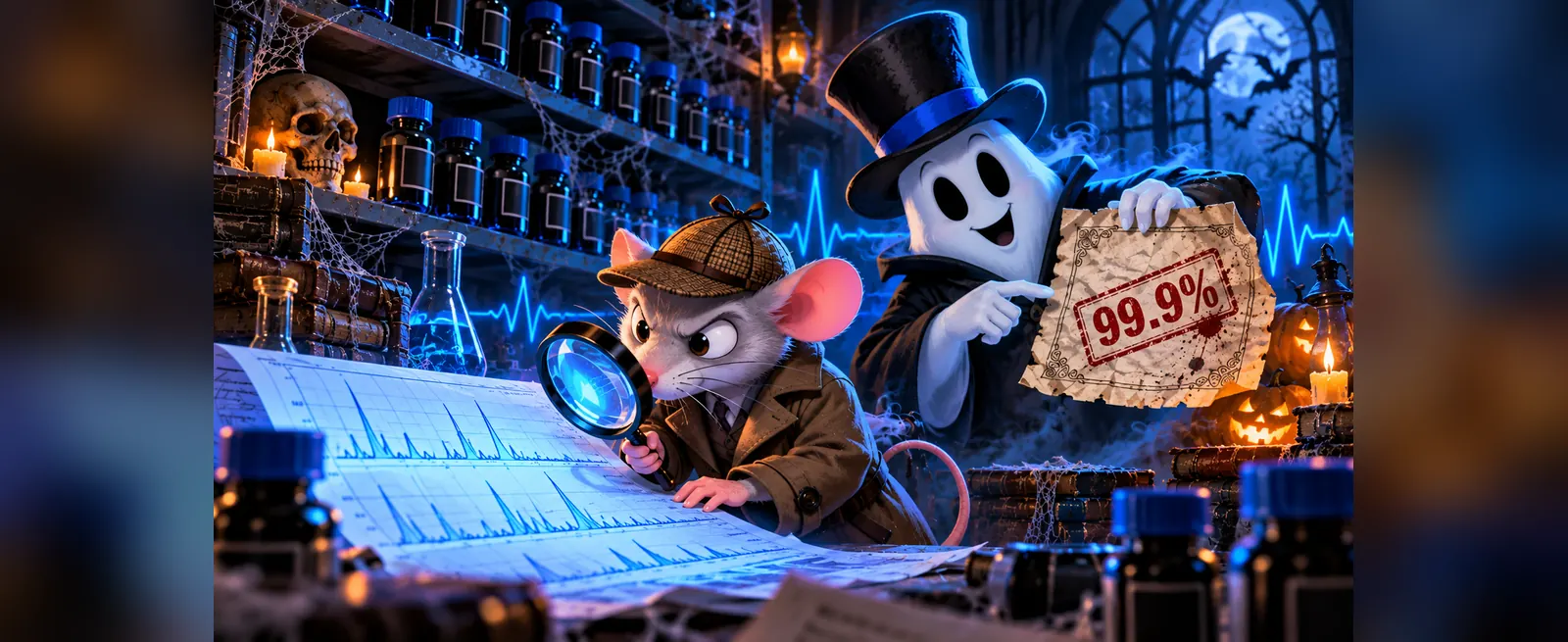
| Raw data | HPLC chromatogram + mass spectrum | A giant “99.9%” in Comic Sans |
| Verification | QR or report code checks out on the lab’s site | “Trust me bro” |
If the batch number on the COA doesn’t match your vial, that COA is about some other vial. Maybe a lovely vial. Not yours.
HPLC Purity: Is It Clean?
HPLC (High-Performance Liquid Chromatography) pushes the sample through a column and draws everything that comes out as peaks on a chart. Purity is the main peak’s share of the total area. Main peak is 99.1% of everything detected? That’s 99.1% purity.
- Want: one tall, skinny peak, with purity at 98% or higher for research-grade material.
- Don’t want: a mountain range. Or, worse, no chart at all.
- Bonus points: retention time and detection wavelength (usually around 214–220 nm) listed on the peptide COA.
HPLC tells you it’s clean. It does not tell you it’s the right peptide. That’s the next guy’s job.
Mass Spec: Is It the Right Peptide?
Mass spectrometry (MS, often LC-MS or ESI-MS) weighs the molecule. A good peptide COA shows the expected mass right next to the observed mass, and they should land within about ±1 Da of each other.
Example: BPC-157 should come in around 1419.5 Da. If it doesn’t, congrats: you bought a very pure mystery. (Want to know why researchers care about BPC-157 in the first place? Read our BPC-157 Achilles rat study breakdown.)
Extra peaks at half or a third of the mass are normal. That’s just multiple charge states. Peptides are dramatic like that.
Fake Peptide COA Red Flags (aka the Vendor Horror Story)
- Same COA for every batch. Every size. Every year.
- Every single product tests at exactly 99.9%. Science isn’t that consistent. Photoshop is.
- Fonts that don’t match, or blurry numbers sitting next to crisp ones.
- A screenshot of a screenshot of a PDF.
- The lab doesn’t exist, or ghosts you when you email. We’re the only ghosts allowed here.
- The observed mass doesn’t match the peptide’s known weight.
The 5-Minute Exorcism: How to Verify a Peptide COA
- Match the batch number on the COA to your vial.
- Google the lab. Real labs have real websites, addresses, and phone numbers.
- Scan the QR code or email the lab with the report number.
- Check the observed mass against the peptide’s known molecular weight.
- Ask the vendor for that exact batch’s COA. Shady ones suddenly have a family emergency.
The Ghost Pulse Standard
Ghost Pulse research materials are USA-lyophilized and COA verified, with batch reports on our Trust page. We’re veteran-owned, so we’ve filled out enough paperwork to respect a good document. Read more about how we vet everything in No Hype, Just Receipts, then go browse the Ghost Pulse shop with your new COA superpowers.
We’d rather show you the data than ask you to believe in ghosts. Other ghosts, anyway.
Peptide COA FAQ
What is a peptide COA?
A Certificate of Analysis is a lab report showing what was tested in a specific batch of peptide, usually purity by HPLC and identity by mass spectrometry, with the lab name, batch number, and test date.
What purity should a research peptide COA show?
Research-grade peptides typically test at 98% purity or higher by HPLC, backed by an actual chromatogram, not just a number.
What is the difference between HPLC and mass spec on a COA?
HPLC measures how clean the sample is. Mass spectrometry confirms the molecule is the right peptide by matching its observed mass to the expected mass.
How can I tell if a peptide COA is fake?
Red flags include a batch number that doesn’t match your vial, the same COA reused for every batch, no raw data, edited-looking fonts or numbers, and a lab that can’t be found or won’t verify the report.
How do I verify a COA with the lab?
Use the lab’s QR or verification code on its official website, or email the lab directly with the report number and ask them to confirm it.
All Ghost Pulse products are sold strictly for research use only. Not for human consumption. Sir, this is research.
Follow @ghostpulse_io on TikTok, X & Instagram for more breakdowns & cheeky content. 👻